
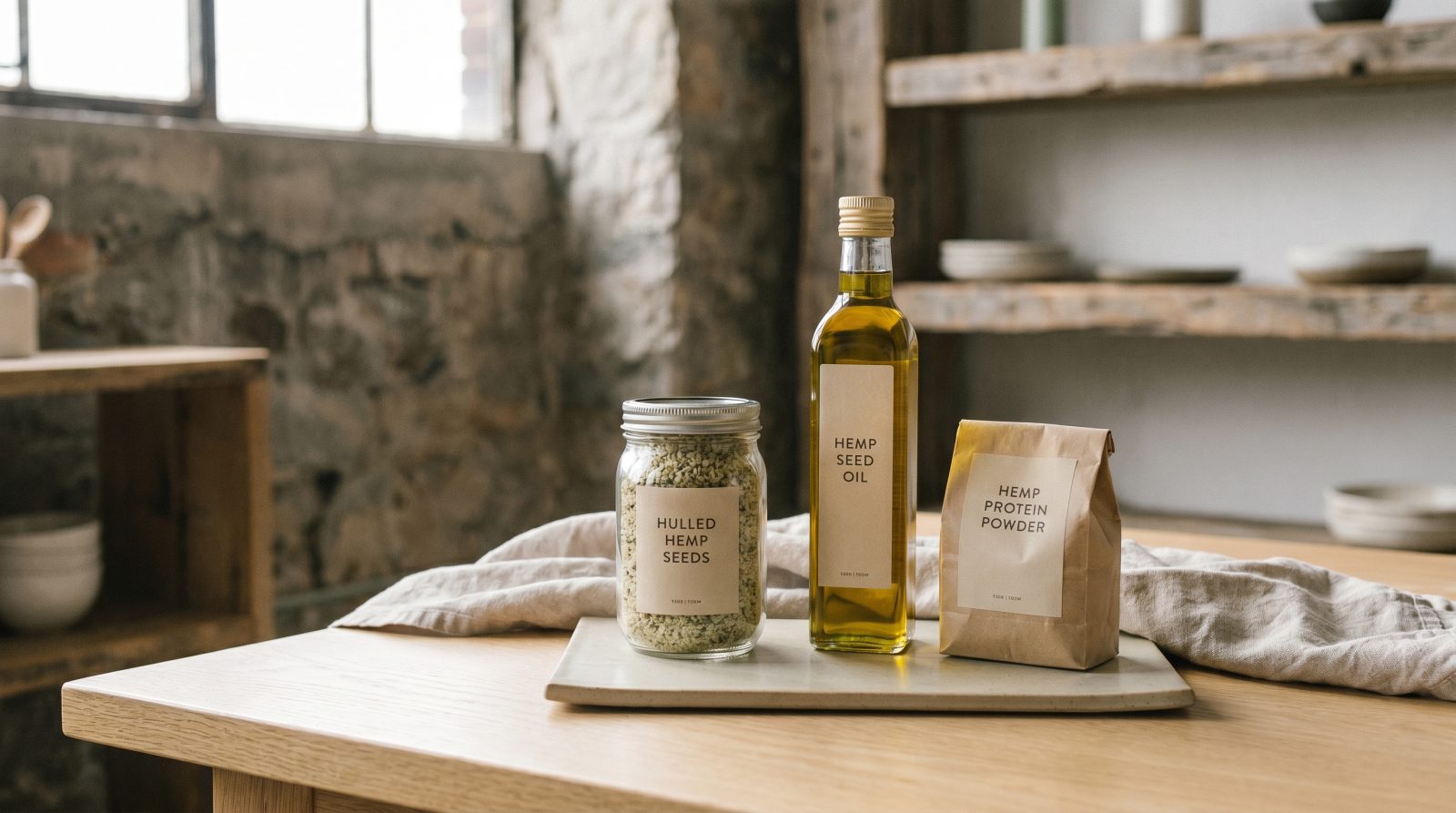
Hemp foods now appear in most Canadian grocery stores, not just health-food shops. This article is a practical shopper's guide: where to find each hemp food, how to read the label, what quality signals to look for, and how to avoid overpaying.
Where hemp foods live in the store
- Hemp hearts: natural foods aisle, baking aisle, or near other seeds (chia, flax). Increasingly in the cereal aisle too.
- Hemp seed oil: with specialty oils, or refrigerated in better stores (the cold case is a good sign for freshness).
- Hemp flour: baking aisle or natural foods section, near alternative flours (almond, coconut).
- Hemp protein: supplement or natural foods section, near other protein powders.
- Bulk: Bulk Barn and similar carry hemp hearts and sometimes hemp protein by weight.
Reading the label: what matters
Ingredient simplicity
The best hemp foods have one ingredient. A bag of hemp hearts should list "hemp hearts" or "hulled hemp seed" and nothing else. Added sugar, oils, or preservatives in a basic hemp product are a signal to look elsewhere.
Country of origin
Canadian-grown hemp is held to documented agricultural standards and the supply chain is short. "Product of Canada" or "Grown in Canada" is a meaningful quality and freshness signal. Imported hemp is not necessarily inferior, but the supply chain is longer and the product may be older.
Best-before date
Hemp's polyunsaturated fats oxidise over time. Buy products with the longest remaining shelf life, and avoid anything close to its date unless it has been refrigerated.
Packaging
Light and oxygen are hemp's enemies. Opaque or foil-lined packaging protects the fats better than clear plastic. Hemp seed oil in dark glass is the standard; clear bottles on a bright shelf are a red flag.
Organic and Non-GMO
Hemp is rarely genetically modified, so "Non-GMO" is largely a marketing reassurance. Organic certification is a genuine differentiator if you prioritise it, and adds roughly 20-50% to the price.
Price benchmarks (Canada, 2026)
| Product | Typical size | Typical price (CAD) |
|---|---|---|
| Hemp hearts | 340 g | $7-12 |
| Hemp hearts (bulk) | 1 kg | $16-26 |
| Hemp seed oil | 250 ml | $10-16 |
| Hemp flour | 454 g | $7-11 |
| Hemp protein powder | 454 g | $15-22 |
Buying larger sizes lowers the per-gram cost, but only if you will use the product before it goes rancid. For occasional users, smaller packages are the better value despite the higher unit price.
Online vs in-store
- In-store lets you check the best-before date and packaging before buying. Best for first purchases and oil.
- Online (Amazon.ca, Well.ca, direct from producers) offers wider selection and bulk pricing. Best for hemp hearts and protein where freshness windows are longer.
- Direct from Canadian producers often gives the freshest product and supports the domestic industry. Many offer subscriptions.
Storage after you buy
- Hemp hearts: refrigerate after opening; sealed, they keep to the best-before date (commonly about 12 months from packing), and opened, about 3 to 6 months in the fridge.
- Hemp seed oil: always refrigerate after opening, and use within about 3 to 8 weeks or as the label directs.
- Hemp flour: refrigerate or freeze; the fat content makes it spoil faster than wheat flour.
- Hemp protein: cool, dry and sealed; the fridge is optional but extends freshness after opening.
The common thread: cold, dark, sealed. Hemp foods reward careful storage with months of extra freshness.