
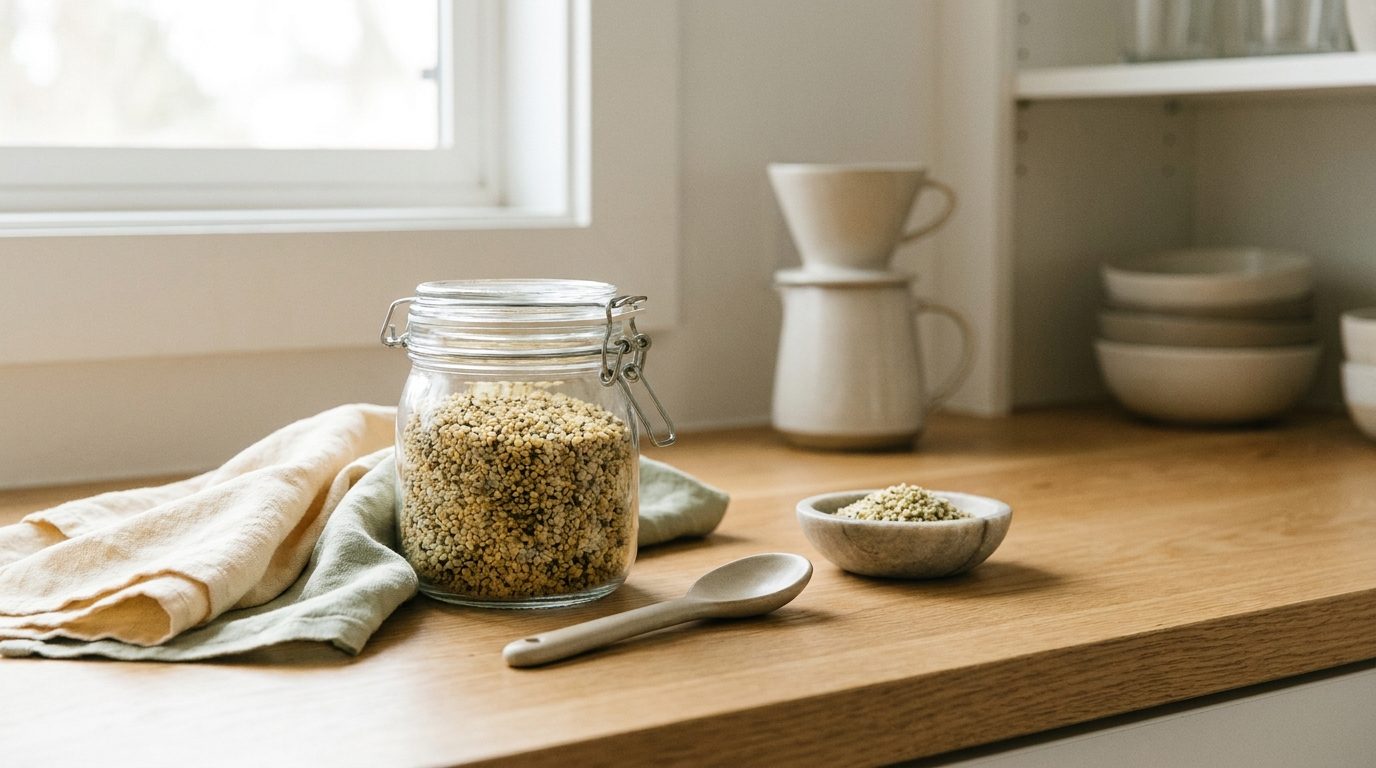
For most people, eating hemp hearts, hemp seed oil or hemp protein is extremely unlikely to cause a failed workplace drug test. The fear is understandable, but the numbers behind it are far more reassuring than the rumour suggests.
Do hemp seeds actually contain THC?
Hemp and marijuana come from the same plant species, Cannabis sativa, but hemp grown for food is a low-THC variety. THC is concentrated in the resin of the flowering tops and leaves, not in the seed itself. Hemp seeds, hemp hearts (hulled seeds), cold-pressed hemp seed oil and hemp protein powder are all seed-derived foods, so they contain only trace amounts of THC at most.
How does any THC end up there at all? During harvest and processing, the outer seed hull can pick up a small residue from contact with the resinous parts of the plant. Modern cleaning and hulling removes the vast majority of it. That is why a hulled hemp heart typically carries even less residue than a whole seed, and why a refined oil can differ from a crude one. The amount is small, variable, and nowhere near the dose found in cannabis intended for its psychoactive effect.
How do workplace drug tests actually work?
A standard workplace urine screen does not look for THC directly in most cases. It looks for THC-COOH, a metabolite your body produces after processing THC. This matters for two reasons.
- There is a cut-off, not a yes/no switch. The most widely used immunoassay screen reports a "positive" only when THC-COOH exceeds a set concentration, commonly 50 nanograms per millilitre. Anything below that threshold reads as negative, even if a tiny amount is present.
- Confirmation tests have a lower cut-off. If an initial screen flags positive, a laboratory runs a confirmatory test (GC-MS or LC-MS) with a stricter cut-off, often around 15 ng/mL. This step exists to catch false positives and verify the first result.
The whole system is built around distinguishing meaningful cannabis exposure from background noise. Trace dietary THC from a serving of hemp food is, in practical terms, that background noise.
So can hemp food make you fail a urine test?
For normal eating, the realistic answer is that it is very unlikely. To approach a positive screen from food alone, you would generally need to consume an unusually large amount of hemp product, every day, made from material with a high THC residue, and even then crossing the confirmation cut-off is far from guaranteed.
A few specific points worth understanding:
- A typical serving is a few tablespoons of hemp hearts, a spoonful of oil, or a scoop of protein, not the cups-per-day quantities that older worst-case studies relied on.
- Hemp food on the market today is generally cleaner than the products that produced alarming results decades ago, because seed cleaning and processing have improved.
- The dose-response is steep: small servings of modern, low-residue hemp food leave you with a wide margin below the screening cut-off.
If you want to be especially careful, you can lower the already-small risk further by choosing hulled hemp hearts over whole seed, favouring products from brands that publish or test for THC content, and not eating very large daily quantities in the days before a scheduled test.
Is there a legal THC limit for hemp food in Canada?
Not any more. From 2018 until March 11, 2025, Canada's Industrial Hemp Regulations exempted products made from hemp grain from the Cannabis Act only if they contained 10 micrograms of THC per gram (10 parts per million) or less, and lots that were imported, exported or sold wholesale had to be tested by a laboratory. Amendments in force since March 12, 2025 (SOR/2025-43 and SOR/2025-44) removed that limit and the testing requirement, and placed products made from non-viable hemp seed outside the Cannabis Act. Health Canada's analysis said these products generally do not contain significant levels of cannabinoids. Hemp foods now have to meet the same Food and Drugs Act requirements as any other food.
With no federal ceiling capping the worst case, the better guide is what hemp food actually does to a urine test. In the best-known controlled study (Leson and colleagues, Journal of Analytical Toxicology, 2001), 15 adults took hemp oil supplying 0.09 to 0.45 mg of THC a day in four 10-day periods, and three of them took 0.6 mg a day in the last period. The oils were deliberately made from less thoroughly cleaned seed and carried more THC than most commercial hemp oils:
| Daily THC intake | Result |
|---|---|
| Up to 0.45 mg | No urine sample screened positive at the common 50 ng/mL cut-off; some did at a stricter 20 ng/mL cut-off, at doses from 0.19 mg |
| 0.6 mg | One sample screened positive at 50 ng/mL; laboratory confirmation measured only 3.0 ng/mL |
| All doses | Highest THC metabolite measured by GC-MS: 5.2 ng/mL, below the 15 ng/mL confirmation cut-off |
The authors equated 0.6 mg a day with about 300 g of hulled hemp seed at 2 micrograms of THC per gram, the level they described as typical of Canadian hemp seed products at the time, and roughly ten times a normal serving. They also cautioned that, with few subjects and screening kits that vary, a positive screen at 0.45 mg a day could not be ruled out. THC content varies by product and lot, which is why the cautions below apply.
What about the "hemp on a label" worry?
Seeing the word hemp on a package alarms some people more than the actual contents warrant. A label simply tells you the seed of the hemp plant is an ingredient. It does not mean the food contains a meaningful dose of THC, and it certainly does not mean it contains CBD or any other cannabinoid in a functional amount.
The genuinely important distinction is between hemp food and hemp-derived cannabinoid products. Hemp seed oil pressed from seed is a culinary oil. A CBD oil or a cannabinoid extract is a different category of product with different rules and, depending on the source, potentially detectable cannabinoid content. Confusing the two is the single most common source of needless drug-test anxiety. If your concern is a urine screen, the relevant question is always whether you have consumed actual cannabinoids, not whether the word hemp appears on a box of cereal or a bottle of cooking oil. You can read more across our article library on how to tell these categories apart.
Who should still be cautious?
A handful of situations warrant extra care, not because hemp food is dangerous, but because the stakes of a single screening result can be high.
- Safety-sensitive and zero-tolerance roles. If you work in aviation, commercial driving, certain trades, or any job with a strict no-cannabis policy, the consequence of even an ambiguous result is severe. Many such workers choose to avoid hemp food entirely in the run-up to testing simply to remove all doubt.
- Athletes under anti-doping rules. Testing programs and prohibited-substance lists vary by sport and body. Confirm what applies to you rather than assuming hemp food is automatically cleared.
- Anyone facing a test with serious personal consequences. When a result affects employment, custody, or legal standing, the cautious move is to abstain beforehand. The risk is small, but it is never worth gambling something that matters when avoiding it costs you nothing.
It is also worth knowing the difference between a true positive and a documented exception. Some testing programs allow a tested individual to declare legitimate hemp food consumption, but you should never rely on this as a plan. It is far simpler to keep your exposure low than to argue your case after a flagged result.
The practical bottom line
If you eat ordinary servings of clean, legally sold hemp hearts, hemp seed oil or hemp protein, the chance of failing a standard workplace urine test is very low: in controlled testing, even a daily THC intake the researchers equated with about 300 g of hulled seed stayed below the confirmation cut-off. The people who should still take precautions are those in zero-tolerance or safety-sensitive roles, where the cost of any ambiguity outweighs the convenience of a food. For everyone else, the sensible approach is straightforward: buy hemp food from reputable brands, favour hulled hearts and quality-controlled oils, keep daily portions reasonable, and if you have a high-stakes test coming up, simply pause hemp food for a week beforehand. That small adjustment makes an already small risk smaller still.